Market update: Third quarter 2025

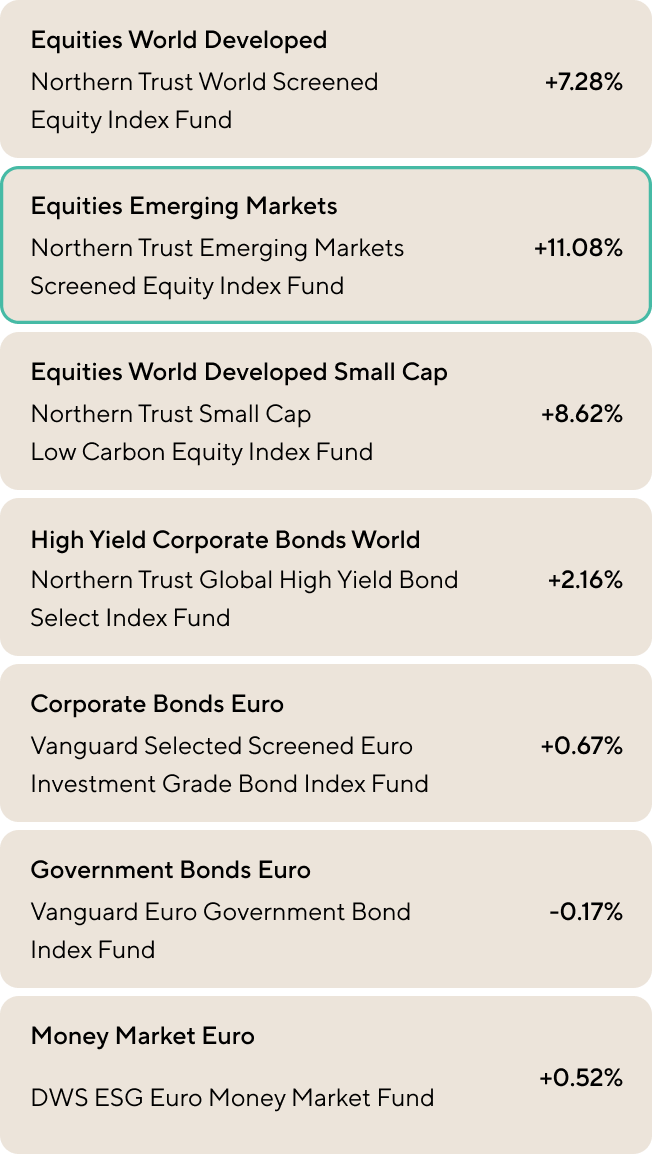
Stock markets in developed and emerging economies showed strong results in the third quarter of 2025. Reduced trade tensions contributed to a more optimistic market sentiment. European government bonds, on the other hand, lagged behind, mainly due to political unrest in France.
Review of the third quarter of 2025: Global markets find their balance between political unrest, interest rate cuts, and growth in emerging economies.
The third quarter of 2025 brought more clarity worldwide regarding the proposed import tariffs by the United States. As the deadline of 1 August approached, the American government increasingly concluded new deals with trade partners or postponed the tariffs further. This led to more optimism in the market.
Although inflation in the U.S. rose slightly, the American central bank (the Federal Reserve) decided in September to cut the interest rate by 0.25%. This decision followed the most recent jobs report, which showed a significant drop in the number of new vacancies. The Fed was thus balancing between its two core tasks: stimulating economic growth and keeping inflation in check. Despite the risk of higher inflation, the central bank opted for an interest rate cut to stimulate the American economy.
Emerging markets experienced a particularly strong quarter. Although the threat of import tariffs persisted, the decreased uncertainty led to a rise in share prices. China, the largest emerging market, also announced extra measures to combat so-called involution. Involution is an exhausting form of hyper-competition in which companies compete each other to death. This occurs in multiple industries in China, such as in the electric vehicle market, where overproduction and price pressure weigh heavily. The announced measures by the Chinese government led to renewed investor confidence.
European government bonds had a less favourable quarter, partly due to the political unrest in France. Prime Minister Bayrou lost a vote of confidence and resigned, while the country struggles with a budget deficit of 5% of GDP, the highest within the Eurozone and well above the EU norm of 3%.
Shortly after the political crisis, credit rating agency Fitch lowered France's credit rating from AA- to A+, which put additional pressure on the financial markets within the Eurozone.
A lower credit rating for France: what does that mean for your investments?
The political unrest and high national debt in France led to a reduction in the country's credit status last quarter: from AA- to A+. But what exactly does that entail and what does it mean for you as an investor?
When governments or companies want to borrow money, they often do so by issuing bonds. Credit rating agencies, such as Fitch and Standard & Poor's, assess the likelihood that the issuer will repay their debt. The highest rating, AAA+, indicates a very reliable borrower. Bonds with a rating up to and including BBB- are considered investment grade, or of investment quality. Below that, we speak of high yield or junk bonds: riskier bonds which come with a higher interest compensation.
The lower the rating, the greater the risk that the issuer will not repay. Investors then demand a higher interest rate as compensation. In other words: a bond with a lower credit rating must become cheaper to remain attractive.
For France, the lower rating means that government loans have become riskier in the eyes of investors. At Vive, we invest partly in French government bonds within the Eurozone government bond fund. The drop in value of these bonds led to a slightly negative return in this fund this quarter.
Our advice: stick to your strategy
The third quarter showed different faces. While global stock markets achieved a solid positive return, other investment categories lagged behind. Whether this positive trend for shares will continue is uncertain. Furthermore, it is also difficult to capitalise on it.
Therefore, our advice remains unchanged: stick to your strategy.
Stay focused on your long-term goals
Do not get carried away by temporary market movements or emotion. Stay focused on your personal financial goals. Only adjust your portfolio if your personal situation changes and not because of the market's whims.
A broadly diversified, systematically managed strategy, such as that of Vive, offers the best basis for long-term success. Trust the process and let your strategy work for you.

Make an appointment
Ready for a modern retirement or wealth solution? Feel free to get to know Vive and discover what's possible - for your organization.
Complex pension, simply explained - know where you are right away
Personal interview for your situation and that of your employees
More clarity than hours of Googling in 30 minutes
Plenty of room for questions to our experienced pension experts