What is the return-on-return effect and how can you optimally utilise it?

Investing is one of the most powerful ways to build wealth. And let's be honest, who wouldn't want their money to do the hard work for them? An important concept that comes into play here is the return-on-return effect, or compounding effect. This effect is essentially a kind of financial snowball that gets bigger and bigger the longer it rolls down the hill. In this article, we'll delve deeper into exactly what the compounding effect is, how it works, and how you can best utilise it to grow your wealth. So, buckle up, we're heading towards your financial mountaintop!
What is the compounding effect?
The compounding effect, also known as the compound interest effect, is the phenomenon where you not only achieve a return on your initial investment but also on the return you generated previously. It's a bit like getting interest on interest, and that interest gets interest again... And so on. Simply put: it's a financial version of "one apple for a rainy day eventually yields a whole fruit basket". Bring on that fruit basket!
For example, imagine you invest €1,000 and achieve an annual return of 6%. After the first year, you have earned €60, making your total amount €1,060. In the second year, you receive a 6% return on €1,060, which amounts to €63.60. That might seem small, but in the long run, this effect can take on gigantic proportions, just like how you simply can't resist “just one more biscuit.”
What is the effect of long-term investing?
The compounding effect works best when you invest over a long period. This is because time is a critical factor in maximising the return. In the first years of investing, the return is like a young sapling that grows slowly. But as the years pass, that sapling grows into a mighty oak, offering you shade (and perhaps some extra acorns) in your old age.
Suppose you invest €1,000 per year for 30 years with a return of 6%. In the first 10 years, your total return will be modest, but after 30 years, you will see exponential growth. This is because you not only achieve a return on your original investment but also on all the returns you earned in previous years. As a result, your wealth grows much faster in the later years than in the first years, a bit like your favourite series which only gets really exciting after season 2.
How does the compounding effect help build wealth?
The compounding effect is one of the most powerful ways to build wealth because it ensures your money multiplies itself. It's as if your money is throwing a party and inviting more and more friends, and best of all: you just get to enjoy the fun (or in this case, your growing wealth).
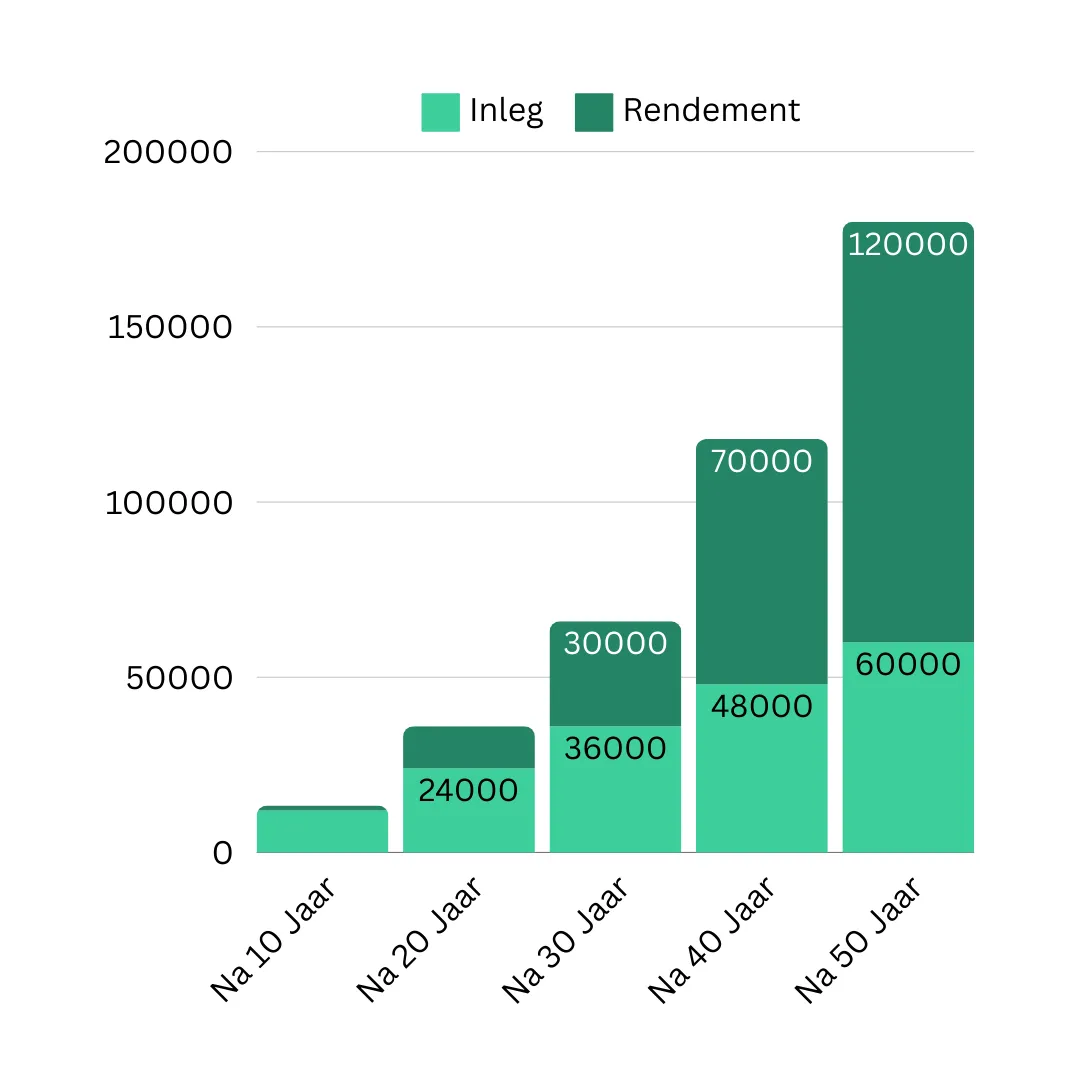
For example, if you decide to leave your investments for 30 years, your wealth will be many times greater than when you only left the same amount for 10 years. The power of the compounding effect lies in time. The longer you have to invest, the more you benefit from this effect. A bit like a well-aged wine, it only gets better with years.
An example of this effect can be seen in the table below:
What is the best strategy to optimally use the compounding effect?
To make optimal use of the compounding effect, there are a few strategies you can follow:
- Start early: The sooner you start investing, the longer you can benefit from the compounding effect. Even small amounts can lead to great results over a long period. Think of that one plant you planted as a seed and which is now taking over your entire balcony. You want that with your money too!
- Invest regularly: Periodic investing helps spread risks and ensures you continuously benefit from the compounding effect. It's like exercising: consistency is key (and it's good for your finances too!).
- Persevere: Patience is essential. It can be tempting to withdraw your investments during a market downturn, but by persevering and allowing your investments to grow, you will ultimately benefit more. Because let's be honest, even that dramatic cliffhanger in your favourite show had a great payoff, didn't it?
- Reinvest your returns: Make sure your returns are reinvested so they become part of the total amount that generates a return. It's a bit like a snowball that keeps getting bigger: it starts small, but before you know it, you have a snowman!
How does periodic investing work?
Periodic investing means you invest a fixed amount on a regular basis, for example, monthly or annually. This has a number of advantages:
- Risk diversification: By investing regularly, you spread the risk across different market moments, which can help absorb fluctuations in the market. Like wearing a raincoat during a hike: you are prepared for unexpected showers.
- Easier to plan: Automatically investing a fixed amount helps maintain discipline and ensures you don't forget to invest. That way, you don't have to worry, just like you never forget your morning coffee.
- Maximise benefit from the compounding effect: Each new investment contributes to the total amount eligible for the compounding effect, which can lead to significant wealth in the long run. It's a bit like that one Netflix marathon: the more you watch, the better it gets!
The compounding effect is a powerful tool for anyone serious about building wealth. By starting early, investing regularly, being patient, and reinvesting your returns, you can optimally benefit from this effect. Investing is not only about the size of the investment but mainly about the time you allow your investments to grow. The longer you take, the more you can benefit from the compounding effect. And remember, just like a good wine, your investment gets better with time!

Make an appointment
Ready for a modern retirement or wealth solution? Feel free to get to know Vive and discover what's possible - for your organization.
Complex pension, simply explained - know where you are right away
Personal interview for your situation and that of your employees
More clarity than hours of Googling in 30 minutes
Plenty of room for questions to our experienced pension experts