What are inflation-linked bonds and why does Vive invest in them?

You can ride out a stock market fall if your retirement is still a long way off. Inflation works differently: it eats away at your purchasing power and doesn't come back on its own. Just before your retirement date, what counts isn't the amount in your account, but what you can buy with it. That's why a Vive pension plan moves a large share of your money into inflation-linked bonds in the final years. Here you'll read how they work, what they cost in calm years, and what happened to them in 2026.
What is an inflation-linked bond?
First, the basic idea. A bond is a loan. You lend money to a government or a company. In return, you usually receive interest, and at the end of the term you get your money back.
An inflation-linked bond (ILB) is a loan to a government whose payments move with prices. With a regular bond, the amount you get back is fixed in advance. With an inflation-linked bond, that amount grows with inflation.
The mechanism lies in the principal. If prices rise, the bond's principal goes up by roughly the same percentage. The interest is a percentage of that principal, so it rises too. If inflation falls, it works the other way round.
Say you buy €1,000 worth of bonds with a ten-year term.
With a regular bond, you receive interest on €1,000 every year, and after ten years you get your €1,000 back. Those amounts are fixed. Prices in the shops aren't. If they rise, that same €1,000 will buy you less later than it does now.
With an inflation-linked bond, the principal grows with prices. If prices have risen by 30%, you don't get €1,000 back but €1,300. Interest is calculated on that growing principal, so your interest payment also rises a little each year. That way, your purchasing power stays roughly the same.
So why doesn't everyone choose them? Because inflation-linked bonds pay a lower interest rate. You give up some interest in exchange for protection against inflation. If inflation rises sharply, you're better off. If it turns out lower than expected, a regular bond would have earned more.
Vive only invests in inflation-linked government bonds from the eurozone with a high credit rating. We also match the term to the moment you'll need your money. That way, as few other risks as possible remain alongside the risk we deliberately choose to take. You can read how we make these choices in our investment policy.
Why does protection cost something in a calm year?
Investors know inflation exists. The market has therefore already priced an expectation of inflation into bond prices. That expected level is called break-even inflation: the inflation level at which an inflation-linked bond and a regular bond deliver roughly the same return.
This leads to three scenarios:
- Inflation lower than expected. The regular bond does better. You paid for protection you didn't need.
- Inflation exactly as expected. The returns of both bonds end up close to each other.
- Inflation higher than expected. That's an inflation shock. The inflation-linked bond does better, because that extra price rise wasn't yet priced in.
Compare it to insurance. In most years you pay a premium and nothing happens. That feels like money down the drain. But the point of insurance isn't the average year. It's the year things go wrong.
One important caveat: an inflation-linked bond removes inflation risk, not all risk. Its price also moves with interest rates. If rates rise, the price falls, just as with a regular bond.
What happened in 2026?
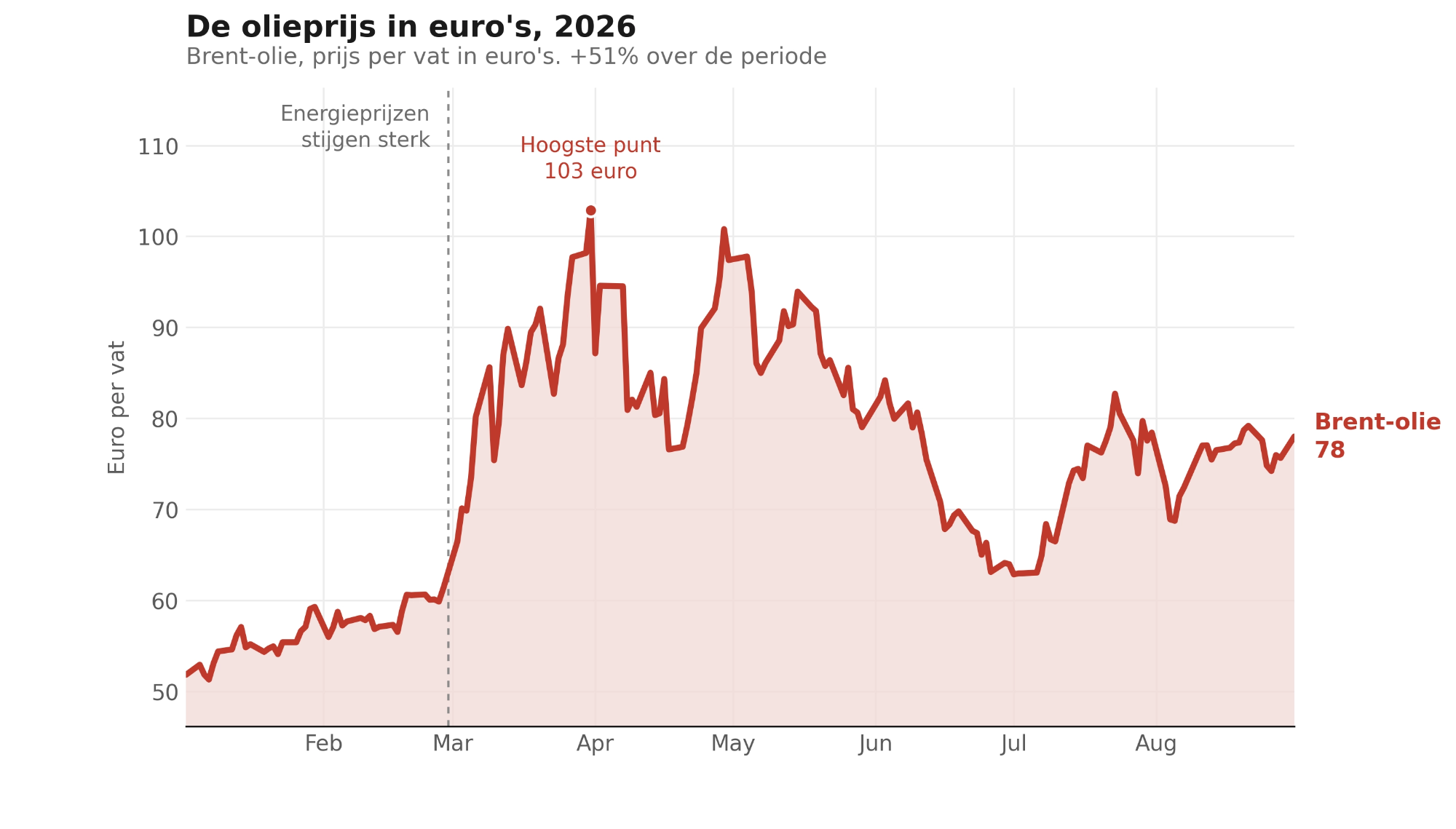
2026 gave an example of such a shock. At the end of February, Iran blocked the Strait of Hormuz, the shipping route through which a large share of the world's oil and liquefied gas passes. Shipping traffic almost came to a standstill and energy prices shot up.
Energy is part of consumer prices, so that rise feeds through into inflation. You can see this in how the eurozone price index developed (HICP excluding tobacco).
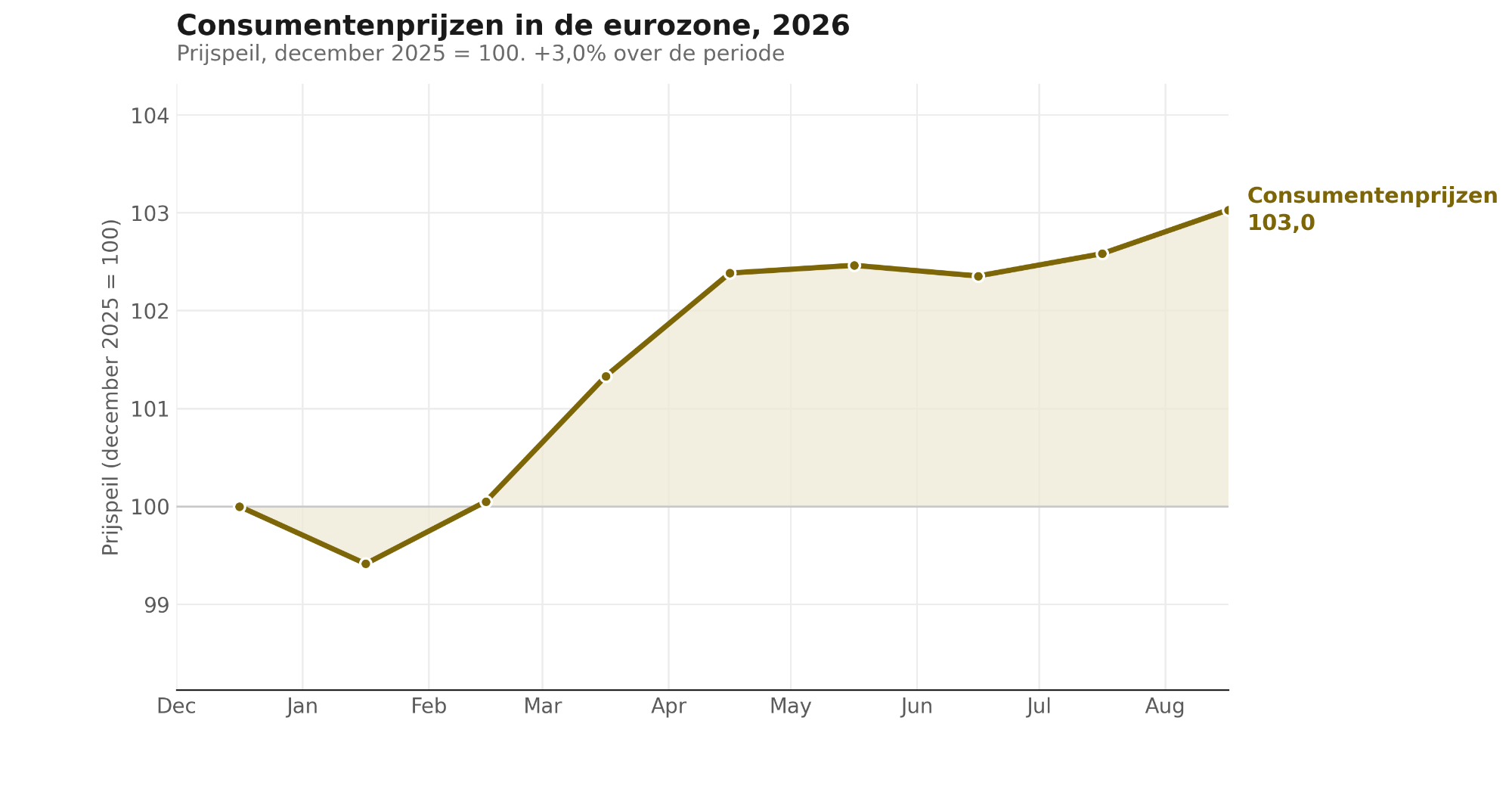
Part of this rise was already priced in, because the market always expects some inflation. What came on top of that wasn't. That's what makes it a shock. So the question is: did the inflation-linked bonds move with it?
Below is what happened to €100 invested at the start of January 2026 in the inflation-linked bond fund and in the regular government bond fund. We use the latter in lower-risk portfolios.
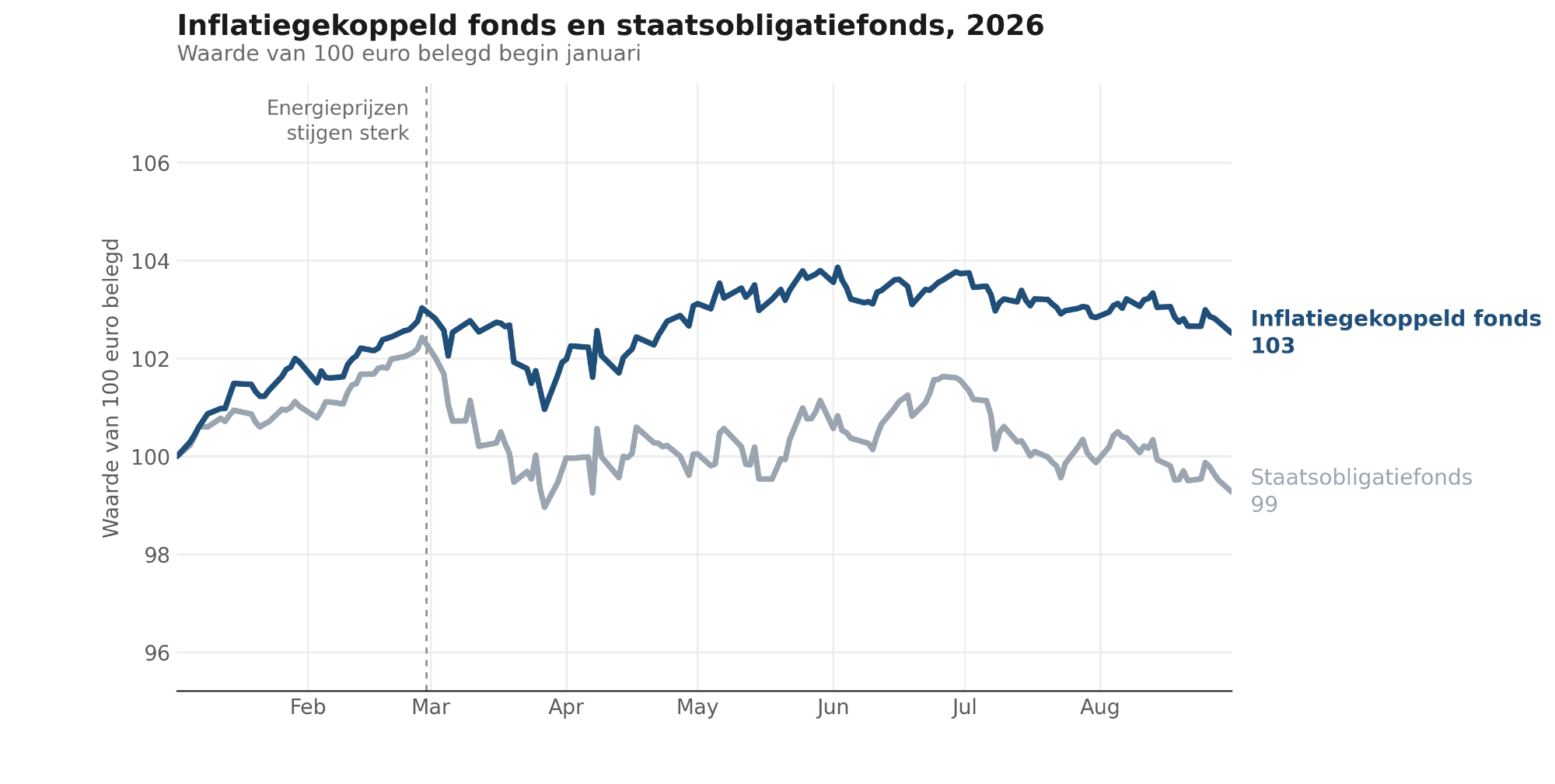
The inflation-linked fund did better. We looked into where that difference came from.
Over this period, the market priced in around 1.7% inflation per year. That's the break-even inflation: the inflation level at which both funds would deliver roughly the same return. This period covered eight months, which corresponds to a priced-in level of around 1.1%.
Inflation turned out higher. The principal of the inflation-linked bonds grew by 2.2% from the end of December to the end of August. That growth is contractually fixed and won't disappear.
On the other hand, you receive a lower interest rate on these bonds. On balance, the higher inflation delivered around 1.1 percentage points extra compared with the regular government bond fund.
But that isn't the whole difference. In total, the inflation-linked fund outperformed by just over 3 percentage points. The remaining difference of roughly 2 percentage points comes from elsewhere. Both funds fell in price as interest rates rose, but the regular government bond fund fell much further. That's because the two funds differ in interest rate sensitivity and in their split across countries, and because the market gradually began pricing in higher inflation.
Two more caveats. Only the growth of the principal has been calculated precisely. We haven't broken down the remaining 2 or so points any further: we know which causes are in there, but not in what proportion. And this is just one period. In another period, the same two funds could move the other way.
Where do these bonds sit in your pension plan?
Your pension plan slowly changes shape. This is called a lifecycle: investment risk decreases as your retirement date gets closer.
While your retirement is still a long way off, your money sits in the growth portfolio. You can adjust its risk level yourself. This portfolio consists of global equities. At this stage, growth matters more than certainty, because you have time to absorb bad years.
You can also choose when the de-risking starts. By default, it begins ten years before your retirement date. From then on, money gradually moves into the protection portfolio, which consists entirely of inflation-linked government bonds from the eurozone.
On your retirement date, the split is 70% protection and 30% growth. Our own analyses show this ratio to be the best balance between reducing risk and keeping room for growth.
What does this mean for you?
In years when inflation does what everyone expected, this part of your portfolio will probably lag slightly behind regular government bonds. That isn't a flaw in the model. It's the price of protection.
If an inflation shock hits in the years just before your retirement date, it will hit most of your pension pot less hard. With these bonds in your portfolio, you're partly compensated. That way, your pension pot is better protected against inflation shocks.
This isn't a guarantee, however. The protection isn't complete, and the 2026 result says nothing about next year.
You don't need to do anything
The shift to inflation-linked bonds happens automatically. We monitor your portfolio daily and rebalance if it drifts too far from your strategy.
What does help: keep contributing and keep your eye on the time horizon that fits your plan. If your personal situation changes, such as your appetite for risk or your retirement date, let us know.
Want to know exactly which funds you're invested in? You'll find them on our funds page.
Investing involves risk. You may lose part of your investment. Past performance is no guarantee of future results.

Make an appointment
Ready for a modern retirement or wealth solution? Feel free to get to know Vive and discover what's possible - for your organization.
Complex pension, simply explained - know where you are right away
Personal interview for your situation and that of your employees
More clarity than hours of Googling in 30 minutes
Plenty of room for questions to our experienced pension experts