War, inflation AND the World Cup. What to do with your money in uncertain times?
.webp)
What to do with your money in uncertain times?
One of the biggest challenges of investing is dealing with uncertainty and market fluctuations. China's strict Covid-19 policy and the urgent situation in Ukraine are the main drivers of uncertainty this year, resulting in inflation, rising interest rates, and increased food and fuel prices.

You notice these consequences in society and on the global stock market. The MSCI All Country World Index (MSCI ACWI Index) is a barometer for the global market, with stocks in both developed and emerging markets. Year-to-date (YTD), the index has fallen by ~16%. Reason enough for investors to wonder what best to do with available and invested capital. What should you do now with money in your (investment) account?
Rest assured. The economic uncertainty that currently has the world in its grip is, in a sense, nothing new. Several financial crises have occurred in the past.
Such a downward movement of the market is part of what investors call a 'market cycle'. A period that usually lasts five to seven years and consists of an upward and downward movement of the market. Although it is not clear in advance exactly how long the cycle will last, the past shows that there is light at the end of the tunnel. Therefore, perseverance is important in uncertain times. But how does that work?
Periodic contributions pay off
Look at the last three major crises through the lens of the aforementioned MSCI ACWI Index. The Dot-com bubble, Financial Crisis, and Corona Crisis have something in common. The performance over a period of 1 to 3 years is astonishing.
People who were able to continue investing during such a difficult period - in which markets collapsed - saw a significant increase in the value of their investments in a relatively short period of time. Research shows that contributing periodically to your investments (for 6 to 12 months) during a crisis works better than making a one-off investment when things are going well. It is best to do this with a solid plan.

It always starts with a plan
“What’s needed is a sound intellectual framework for making decisions and the ability to keep emotions from corroding that framework.” - Warren Buffet
What the world-famous investor and CEO of Berkshire Hathaway means is simple. Successful investing starts with the right plan of action. Such a plan consists of two parts.
🧭 A strategy that determines how you achieve your long-term goals and what your approach is in different situations. This helps you to remain disciplined in times like these, so that emotions don't mess up your goals and cause you to step out (too quickly) or lock in your losses.
🧇 A portfolio that aligns with your goals and strategy. This is a distribution of different types of investments, such as stocks, bonds, and cash, the composition of which you adjust if necessary (rebalancing). Rebalancing adjusts the portfolio to market conditions to (temporarily) take more or less risk and thus protect your capital or increase the chance of returns.
In short. To invest in uncertain times—so that you achieve your long-term goals—you need a plan, with a strategy and a good portfolio composition. This makes you less sensitive to the market and your emotions. Because even though it may not feel like it now, there is also light at the end of the tunnel in this crisis.

Diversification protects capital
You build the portfolio of your plan through diversification. This is a tactic to manage investment risk by creating a mix of different investments within a portfolio. Instead of concentrating your capital in one company, stock, sector, or industry, it is wise to spread your investments as widely as possible, across different companies, industries, and 'asset classes'. An asset class is no more than a type of investment, such as stocks or bonds, but it can also be real estate or crypto.
Spreading works in your favour because not all investments develop in the same way over time. Take a look at this figure.

You can see that during the weaker periods, when the return on stocks (equity) was quite poor, the results of other asset classes were significantly better. Looking at the table below, you can see that this principle even applies during the three major (financial) crises. If your portfolio at that time consisted of a good mix of equity and bond funds, you would have, simply put, lost less money than if you had only invested in 'equity'.
As an additional advantage, by diversifying, you also had more capital to deploy as soon as the (stock) markets improved again. Although it is obvious not to put all your eggs in one basket—this remains an insight that many people overlook.

Do you already have a well-diversified portfolio in a time of high market fluctuations? Then it might be smart to rebalance your portfolio so that the risk level matches your goals.
Why not leave money in the bank?
An open secret: inflation is making everything more expensive at a rapid pace. As you can see in the table below, and as you already know, the savings interest rate in the Netherlands has still not really moved.
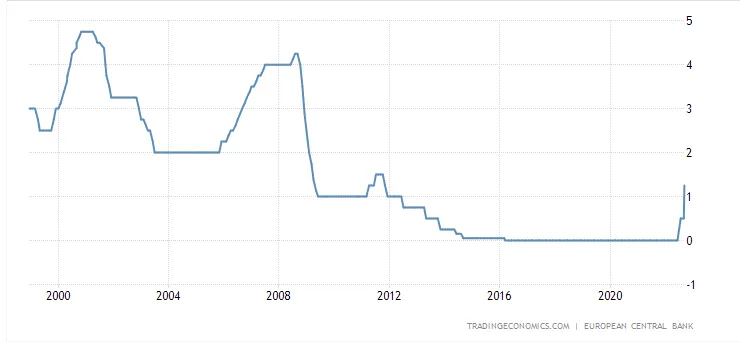
This means tough times for the money sitting in your bank account if you don't do anything with it. In the financial market, this is called 'negative real returns'. This means that by not investing or substantially increasing your income, you run the risk of not being able to maintain the same standard of living. You will then have to adjust your lifestyle by, for example, spending less or saving on holidays, energy costs, etc. Simply because your money is worth less and, at the same time, the return on your money is too low to compensate for this.
People therefore divide their capital into different terms and goals. But instead of using different savings jars, they use this division to generate returns on parts of their capital. That is smart capital allocation. A few tips:
☂️ A financial buffer is the starting point. Your buffer should cover about 6 months of your living expenses. You determine for yourself how critical this is and put this money into an account that you can easily access.
🧦 Only invest in stocks with money you do not expect to spend in the next five years. Make sure you set goals for your plan that require five years or more, such as studying, a sabbatical, or perhaps retirement or a world trip.
🏠 Buying a house in the future is a possible exception to your five-year rule for investing. This is because there is an increasing similarity between the stock market and the housing market. It can therefore be worthwhile to start a plan for a house and use this money for the purchase in the future, even if this is within the five-year rule.
So what should I do?
If you are considering starting to invest, if you have spare money in addition to your buffer, or if you have sold some of your crypto, you could use that capital to gradually (periodically) build a diversified portfolio over the next 6-12 months. Keep the following in mind when creating a plan:
- Ensure a long investment horizon.This way, you don't have to worry about a bad week, month, or even year.
- Evaluate your goals every six months.Are you still on track to achieve your goals, or decide what you want to do with new savings.
- Manage your risk so that it doesn't manage you.Create peace and focus by determining in advance how much risk you can take to achieve your goal.
- Put together a diversified portfolio.Determine the type of investments for diversified (and, for example, sustainable) investing.
Vive helps you invest for the future
No knowledge, time, or inclination to make a plan yourself? But ready to invest? With Vive, you can create an investment plan for free. For every goal you have, you can create a plan in a few minutes, so you achieve that goal as effectively as possible. Compare it to a car navigation system that knows the best way to reach your destination. That plan is entirely tailored to your financial situation, the market, and your goals. In our opinion, this is the best way to build capital for the future. You then decide whether we execute and monitor it for you.
Your plan advisor
With Vive, you gain access to unique wealth management features such as the plan advisor who gives tips on how to improve your plans. Our plan advisor provides real-time insight into the status of your plans and whether you need to adjust course to achieve your goal, or if the markets are not performing as expected.
Because your plans are monitored, you don't have to do the rebalancing yourself. As a wealth manager, Vive monitors your plans day and night and ensures that the necessary actions are taken to keep you on course. Aye aye, captain!
What does the World Cup have to do with this?
If we've learned anything from the football matches at the World Cup in Qatar, it's that the outcome can totally deviate from expectations. Predicting events or the outcome is impossible. Ultimately, the best strategy is to create a plan and ensure good diversification of your investments. That is how you eventually win all the matches.
🌱
Good to know
Vive's statements are compiled for informational and entertainment purposes. The content should not be considered financial advice. Do not take unnecessary risks and always read the essential investor information in advance. Investing involves risks.
Make an appointment
Ready for a modern retirement or wealth solution? Feel free to get to know Vive and discover what's possible - for your organization.
Complex pension, simply explained - know where you are right away
Personal interview for your situation and that of your employees
More clarity than hours of Googling in 30 minutes
Plenty of room for questions to our experienced pension experts