
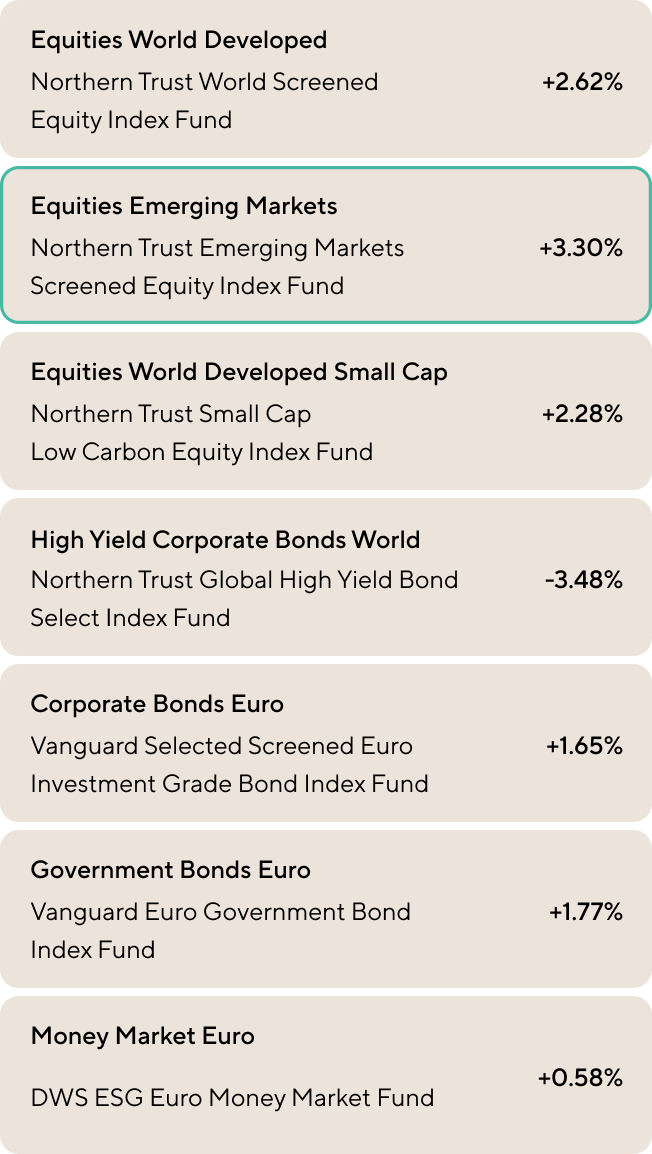
The second quarter of 2025 was dominated by import tariffs. Although these initially caused historic market declines at the start of the quarter, it ultimately ended on a positive note with high equity prices.
Following a turbulent first quarter, the second quarter began on 2 April with a far-reaching measure from Washington. On ‘Liberation Day’, the US government announced a broad package of import tariffs affecting almost all global trading partners. The scale of these measures was larger than expected. This led to sharp declines across global equity markets. The MSCI World Index, which tracks large listed companies worldwide, lost more than 10% of its value in five days.
Shortly afterwards, the US decided to temporarily postpone the introduction of the tariffs in order to allow room for diplomatic negotiations. This resulted in a rapid recovery in market sentiment. By the end of April, the MSCI World Index had already risen above its pre-Liberation Day level. The recovery continued in May, supported in part by a 90-day postponement of reciprocal tariffs between the US and China.
In addition, most companies reported positive first-quarter earnings results. The European defence sector and the US IT sector performed particularly strongly. By contrast, US healthcare companies came under pressure as a result of President Trump’s “Big Beautiful Bill”, which proposes significant cuts to the Medicaid programme. Medicaid provides health insurance for low-income individuals in the United States.
In June, investor confidence increased further. The US stock market, as measured by the S&P 500, reached a new all-time high in dollar terms. European investors benefited less from this due to the weakening of the US dollar against the euro. The decline of the dollar was driven mainly by concerns over the high level of US government debt, which is expected to rise further as a result of recent legislation by the Trump administration.
The euro strengthened against the US dollar over the past quarter, particularly following the ECB’s interest rate cut combined with weaker-than-expected economic data from the US. For European investors, this has direct consequences: because returns are expressed in euros, the decline of the dollar led to lower returns on US investments. Even if the price of a US share rises in dollars, the depreciation of the dollar can limit the gains for a European investor.
A notable development was the strong performance of safe European bonds. Following the ECB’s rate cut and the prospect of a more accommodative monetary policy, the prices of many government and corporate bonds increased. This provided relief for more defensively positioned investors, who had previously been affected by rising interest rates earlier in the year. There were renewed capital inflows into European and emerging markets, partly driven by expectations of investment in infrastructure, defence and digitalisation. Nevertheless, the global market share of US companies remains large, particularly within the technology sector.
The second quarter once again confirmed that financial markets can be volatile. At the same time, this period also demonstrated the resilience of both markets and portfolios. One key element of Vive’s investment approach that proved particularly effective this quarter is our automatic rebalancing.
Vive monitors the composition of each portfolio on a daily basis. When the allocation between asset classes (such as equities and bonds) deviates too far from the target allocation, the portfolio is automatically rebalanced. In practice, this creates an anti-cyclical effect: when equities fall sharply relative to bonds, Vive buys equities and sells bonds, restoring the portfolio to its intended balance.
This means you buy equities when they are relatively cheap and sell bonds when they are relatively expensive. While this may sound logical, many investors tend to sell an investment when it is performing poorly. Conversely, many investors enter an investment after it has shown strong recent returns. This leads to buying high and selling low. Vive avoids this common investor pitfall on your behalf.
Do not be discouraged by temporary market movements. Keep your personal financial goals clearly in focus and adjust your portfolio only when your personal circumstances change — not in response to short-term market fluctuations. By sticking to your strategy and not reacting to emotions or market swings, you increase your chances of achieving your financial objectives.
A broadly diversified, systematically managed strategy such as Vive’s provides the strongest foundation for long-term success