
The fourth quarter of 2024 presented a mixed picture. The significant victory of the Republicans in the US elections had far-reaching effects on global equity markets.
The fourth quarter of 2024 showed mixed results across equity markets. The election of Donald Trump as president in November had a substantial impact on financial markets. In the US, this led to a strong rise in share prices, as investors expect Trump’s policies to result in lower taxes, deregulation and subsequent profit growth. However, the US equity market was tempered towards the end of the quarter by a reduction in the number of expected interest rate cuts in 2025 by the US central bank, the Federal Reserve.
Equities in the EU experienced a less favourable period. Political instability in France and Germany created uncertainty, alongside ongoing concerns about stagnating economic growth. In emerging markets, the election of Donald Trump had a negative effect. Concerns about the consequences of potential US trade tariffs, particularly against China, pushed share prices in these markets lower. In addition, the strong quarter in the US led to a strengthening of the US dollar against local currencies in emerging markets.
Bond markets also had a difficult quarter. Geopolitical tensions and persistent inflation weighed on investor confidence. The aforementioned moderation of expectations by the Federal Reserve in December led to a decline in the value of high-quality bonds in the US. In Europe, political instability in Germany and France reduced confidence in government bonds. In Germany, the governing coalition of Social Democrats, Liberals and Greens collapsed, with voters heading back to the polls on 23 February 2025. In France, Prime Minister Barnier lost a confidence vote on the proposed budget and was forced to submit the resignation of his cabinet to President Macron.
There was, however, a bright spot in the bond market. High-yield corporate bonds performed well during the quarter. Investors expect Trump’s pro-business policies to benefit these companies, which led to an increase in the value of their bonds.
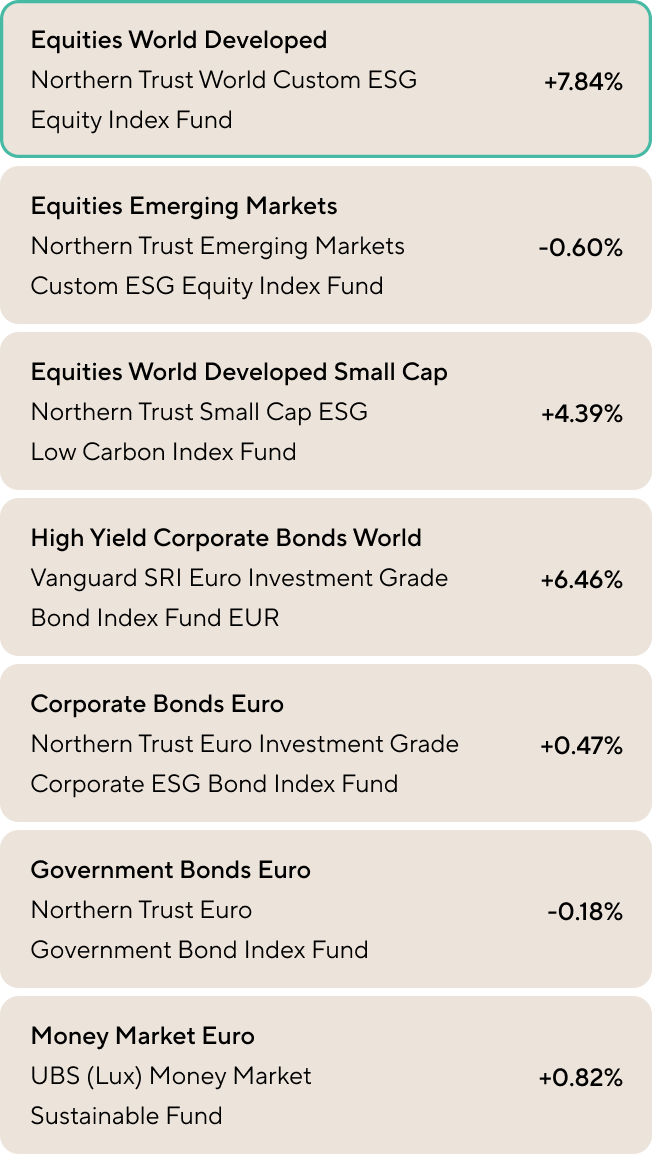
This quarter once again highlighted the significant influence of the US on global markets. American companies play a dominant role in many sectors, such as technology, pharmaceuticals and consumer goods. As a result, global equity funds, such as the Northern Trust World Custom ESG Equity Index Fund, often have a high allocation to US equities. This is because the weighting in these funds is based on companies’ market capitalisation. Since many of the largest and most valuable companies in the world are American, they make up a substantial portion of such funds. The positive performance of US equities provided a strong boost to these funds.
The negative performance of emerging market equities is also a clear example of the influence of the US. The threat of potential US import tariffs had a negative impact on emerging markets such as China. In addition, the US dollar received a boost during the fourth quarter due to positive developments in the US economy. A stronger dollar often has a negative effect on emerging markets. Commodities such as oil and metals become more expensive because they are traded in dollars. Furthermore, servicing debt — much of which emerging countries hold in dollars — becomes more costly.
Our advice: stick to your strategy
Should you constantly follow the news from the US and adjust your portfolio accordingly? No. It is impossible to time the market. Moreover, the impact of specific factors, such as US presidential elections, is difficult to assess in advance (even if it may seem obvious in hindsight). Our advice remains the same: do not be guided by short-term market movements. The Vive investment model ensures that your portfolio is optimally diversified for your risk profile. Fluctuations like these have little impact in the long term.
Keep your long-term goals in sight
Do not allow the market to disrupt your long-term goals. Stay focused on your personal objectives and adjust your portfolio only when your circumstances change, not in response to temporary fluctuations. Following a well-diversified strategy remains the key to long-term success.